If you are looking at 78702 for your next infill deal, broad Austin headlines will only get you so far. East Austin offers real opportunity, but parcel-level details still decide whether a project is simple, delayed, or not viable at all. This guide walks you through how to think about zoning, risk, permit paths, and resale in 78702 so you can underwrite with more clarity and fewer surprises. Let’s dive in.
Why 78702 Draws Small Developers
78702 is an established infill submarket, not a blank-slate subdivision environment. That matters because your deal is shaped by existing lot patterns, nearby zoning, overlays, drainage conditions, and neighborhood planning context.
Recent market data helps explain the appeal. Redfin reported an April 2026 median sale price of $649,673 in 78702, median days on market of 60, a 96.9% sale-to-list ratio, and a Walk Score of 76/100. That combination points to a location where demand exists, but outcomes still depend heavily on product type, finish level, and pricing discipline.
The range of recent closed sales also shows why many small developers stay focused here. Newer and attached infill-style homes have sold from roughly $595,000 to $1.19 million, which suggests real exit potential, but not a one-size-fits-all formula.
Start With Parcel-Level Diligence
In 78702, ZIP-code averages are useful for context, but they are not enough to underwrite a specific lot. The City of Austin has expanded options for ADUs, three-unit projects, and small-lot housing, yet zoning, overlays, compatibility, and floodplain rules still shape what you can actually build.
That is why your first step should be verifying the parcel itself. Austin’s Property Profile tool is designed to help you review zoning information, development regulations, and other property details by address. If you need a formal document for legal, financial, or development purposes, the city also offers a Zoning Verification Letter.
Check Base Zoning First
Before you model unit count or resale value, confirm the property’s base district. Austin states that zoning controls key development standards such as height, setbacks, bulk, and impervious cover.
In many 78702 scenarios, the first question is whether the site is in SF-1, SF-2, or SF-3, since those districts are directly tied to current ADU, HOME Phase 1, and small-lot opportunities. If you skip this step, the rest of your underwriting can drift off course quickly.
Review Overlays and Combining Districts
The base district is only part of the picture. Austin’s zoning materials note that overlays and combining districts can modify what the base zoning allows.
That matters in East Austin because planning and policy layers are active here. City staff reported in 2025 that several neighborhood plans cover parts of 78702, including East Cesar Chavez, Chestnut, Holly, Central East Austin, Rosewood, and Govalle/Johnston Terrace. Staff also noted that the East Austin Overlay was adopted to limit overly permissive commercial and industrial uses, which is a reminder that land use context still matters even as housing rules evolve.
Screen Historic Flags Early
If a parcel involves a historic structure or sits in a National Register district, Austin says additional requirements may apply. In practice, that means you should identify those issues at the front end, not after you have already spent time and money refining plans.
For small developers, this is one of the easiest ways to avoid a false start. A lot can look straightforward on paper but become more complex once preservation-related review enters the process.
Understand Compatibility Before You Price Height
One of the most common underwriting mistakes in central Austin is assuming the allowed unit count tells the whole story. In reality, compatibility standards can affect what you are able to do with height and setbacks on certain edge lots.
Austin’s compatibility guidance says these standards can apply to property that adjoins, faces, or sits within 540 feet of SF-5 or more restrictive zoning. When they apply, they can reduce practical building envelope even if the base zoning appears favorable.
This is especially important in 78702, where lot patterns and zoning edges can shift quickly from one block to the next. If your design depends on vertical massing or tight site planning, compatibility needs to be reviewed before you assume your numbers work.
What You Can Build Under Current Austin Rules
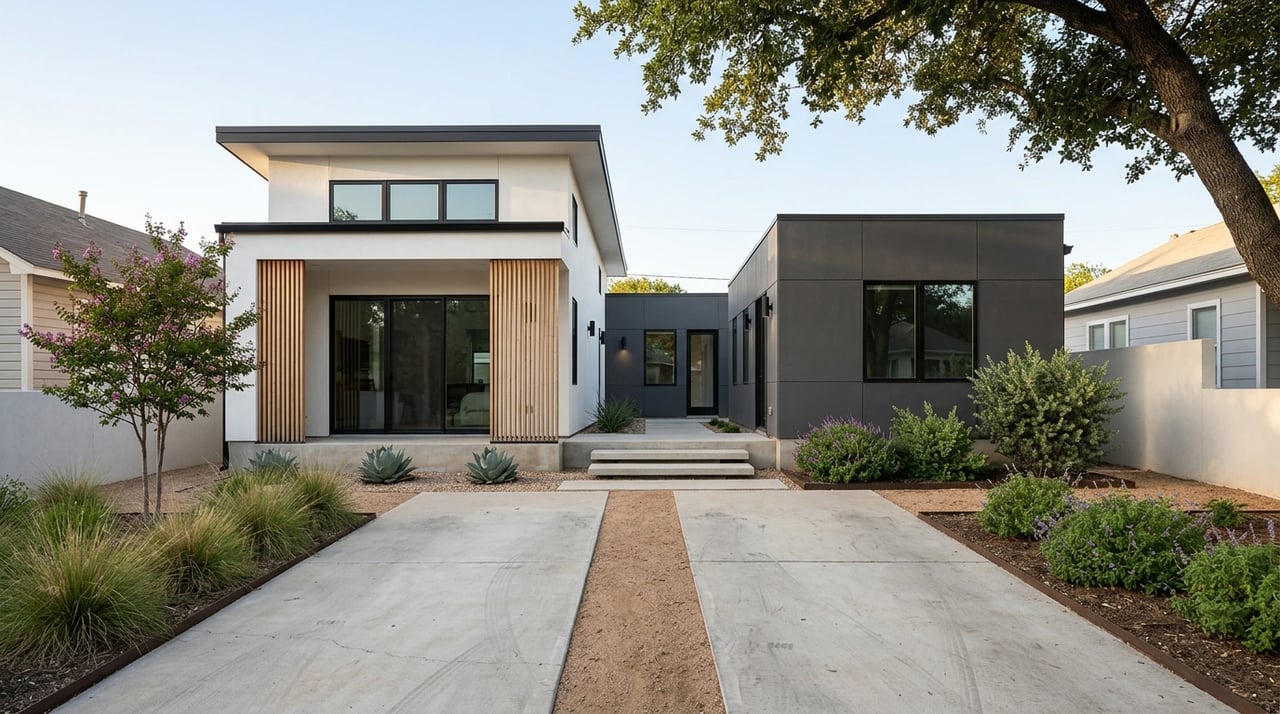
Austin’s recent HOME changes created more paths for small-scale housing, but the right route depends on the lot. In 78702, the main options for many small developers are ADUs, two- and three-unit projects, and small-lot single-family development.
ADU Path in 78702
Austin allows an additional dwelling unit on SF-1, SF-2, or SF-3 property when the lot is at least 5,750 square feet. The city says there is no zoning minimum distance between units, and each new dwelling needs a unique address.
Austin also states that ADUs built after October 1, 2015 can only be used as short-term rentals under city restrictions, with use capped at 30 days per calendar year. If your pro forma assumes more short-term rental flexibility than that, it needs to be adjusted.
Two- and Three-Unit Path
Under HOME Phase 1, Austin allows up to three housing units on SF-1, SF-2, and SF-3 lots. The city says these projects may have up to 40% building coverage and 45% impervious cover, with no zoning minimum separation between units.
Austin also notes that single-family residential still follows the older Subchapter F height limit of 32 feet. As with ADUs, every dwelling in a two- or three-unit use must have its own unique address.
Small-Lot Single-Family Path
HOME Phase 2 created a small lot single-family use for parcels between 1,800 and 5,750 square feet in SF-1, SF-2, and SF-3. For existing lots already below 5,750 square feet, Austin says the route is a building permit application.
For new lots, the city created an infill subdivision path. That path must be a replat, stay at or below 1 acre, involve residentially platted land, and avoid plat vacation. Austin also adopted drainage updates in 2025 for most residential re-subdivisions of one acre or less, so subdivision strategy and drainage review now need to be considered together.
Know the Permit Path Before Design Starts
A clean permit path can save time, carrying cost, and redesign expense. Austin’s Residential Infill Tools page says that 3-4 unit projects in the city’s zoning jurisdiction do not need a site plan or site plan exemption, though they still require the proper building permit and remain subject to zoning and floodplain rules.
That can be a major advantage for small developers trying to simplify execution. Still, the lack of a site plan requirement does not erase issues like floodplain review, drainage, or zoning compliance.
If you move into 5-16 units, Austin uses Small Project Site Plans and Site Plan Lite. The city says no drainage studies or detention ponds are required below 8,000 square feet of impervious cover, and a simplified drainage plan is required above 4,000 square feet of new impervious cover.
For 78702 deals, this means the entitlement path may change materially with even a modest increase in scale. A site that works cleanly as a three-unit project may become more complicated if you try to push density beyond that threshold.
Floodplain and Drainage Are Not Side Notes
In East Austin, climate and site risk should be part of underwriting from day one. Redfin’s First Street layer flags 78702 for moderate flood risk and severe wind and heat risk, and Austin states that floodplain, drainage, and water-quality review are part of the development process.
That is not just a design issue. It can affect timeline, cost, grading options, impervious assumptions, and even whether your preferred unit layout remains practical.
Austin also makes clear that drainage easements, floodplain rules, and utility coordination are part of review. For a small infill project, those constraints can matter as much as zoning because they shape what portion of the lot is truly usable.
Deed Restrictions and Utilities Still Matter
One of the easiest mistakes to make is assuming city zoning answers every feasibility question. It does not. Austin’s ADU guidance specifically tells applicants to verify restrictive covenants, and that should be treated as a separate diligence item.
The same goes for utility and drainage constraints. A parcel may appear attractive on a map, but if it has awkward easements or utility coordination issues, the effective building area and development cost can change fast.
How to Think About Resale in 78702
The resale story in 78702 is real, but it is highly product-specific. Redfin describes the market as somewhat competitive, with about one offer per home, median days on market of 60, and 38.6% of homes showing price drops.
That suggests buyers are active, but not indiscriminate. Clean design, sensible unit mix, finish quality, and realistic pricing all matter more than broad assumptions about East Austin appreciation.
Recent closed sales show the spread clearly. Redfin’s 78702 sold feed includes 2503 Bryan St at $595,000, 1913 Canterbury St #2 at $725,000, 1037 Nile St #3 at $874,000, 903 E 14th St at $1.19 million, and a 0-bed transaction at 3023 Garwood St at $650,000.
The takeaway is simple: underwrite exits using relevant nearby product, not citywide averages and not a single comp that happens to support your target price. In 78702, the margin between a good deal and a frustrating one often comes down to realistic resale assumptions.
A Practical 78702 Infill Checklist
If you are reviewing a small development opportunity in East Austin, use this sequence before you get too deep into design or pricing:
- Pull the Property Profile and confirm zoning, overlays, and historic flags.
- Verify lot area, frontage, legal creation, deed restrictions, and whether the site can support an ADU, two-unit, three-unit, or small-lot single-family use.
- Screen floodplain, drainage, and compatibility early, especially if the parcel is near SF-5 or more restrictive zoning.
- Choose the cleanest permit path before design starts.
- Model the exit using recent 78702 sales that actually resemble your future product.
- Bring in local expertise when overlays, historic review, floodplain issues, or unusual lot geometry make the path unclear.
Why Local Advice Matters More in 78702
Austin’s updated housing rules have opened real opportunities for small developers. The city’s own HOME data shows strong early use, with 771 applications reviewed, 607 approved, and 1,206 new units approved as of May 4, 2026.
But more options do not mean less diligence. In 78702, the best opportunities often come from understanding the block, the lot, and the permit path better than the next buyer.
That is where owner-led, development-savvy guidance can create real value. If you want help evaluating a 78702 parcel, pricing a future exit, or positioning an infill project for the strongest resale outcome, connect with Derrik Davis for a tailored consultation.
FAQs
What makes 78702 different from a typical suburban development market?
- 78702 is an infill market shaped by existing lot patterns, zoning, overlays, compatibility, and drainage constraints rather than large greenfield planning assumptions.
What should you check first before underwriting a 78702 infill lot?
- Start with Austin’s Property Profile or a Zoning Verification Letter to confirm base zoning, overlays, development rules, and any historic flags.
What housing types can you build on many SF-1, SF-2, or SF-3 lots in Austin?
- Depending on the parcel, current Austin rules may allow an ADU, up to three housing units under HOME Phase 1, or small-lot single-family use under HOME Phase 2.
Why do compatibility standards matter for East Austin infill projects?
- Compatibility can affect height and setbacks on lots adjoining, across from, or within 540 feet of SF-5 or more restrictive zoning, which can shrink the practical building envelope.
Do 3-4 unit residential projects in Austin need a site plan?
- Austin says 3-4 unit projects in the city’s zoning jurisdiction do not need a site plan or site plan exemption, but they still need the correct building permit and must comply with zoning and floodplain rules.
How should you estimate resale value for a 78702 small development?
- Use recent 78702 sales that closely match your future product because pricing in this market varies widely by design, size, finish level, and location.