Zilker Schools: What Families Actually Need to Know
Neighborhood Guide · August 2026
The short answer: Zilker is served by Austin ISD, with Zilker Elementary inside the neighborhood. Central Austin campuses generally feed through O. Henry Middle School into Austin High. But the word "generally" is carrying weight — AISD assigns by individual home address, not by neighborhood, and an elementary school can feed into more than one middle school. Before you write an offer, run the specific address through the district's school finder.
Schools are usually the second question a family asks about Zilker and frequently the one that decides whether they buy here. Here's how the district actually works, what the neighborhood's campuses offer, how boundary changes happen, and an honest look at the Eanes comparison that pulls a lot of families across the bridge.
Talk Through NeighborhoodsCall (512) 608-8811
AISD The District Zilker Elementary sits in the neighborhood | ADDRESS Not Neighborhood Assignment is determined parcel by parcel | OCTOBER Annual Boundary Review AISD reviews a 10-year demographic report each year | EANES The Alternative Across the bridge, and a different trade entirely |
The Feeder Path, and Why It Isn't a Guarantee
Central Austin follows a fairly clean pattern. Several central elementary campuses feed through O. Henry Middle School and into Austin High, while a separate central cluster routes through Lamar, Kealing or Webb and into McCallum. Zilker sits in the first group, and Austin High — on Cesar Chavez right at the river — is a genuinely central campus, which matters to families who don't want a twenty-minute drive twice a day.
Here's the part that gets glossed over in most neighborhood guides. AISD is explicit that the feeder pattern shows the sequence students are assigned to, but that each child's exact path is determined by their home address. The district also states plainly that while the goal is keeping students together between levels, schools are sometimes split into multiple feeder patterns — an elementary school can feed into two or more middle schools, and a middle school into two or more high schools.
So "Zilker feeds Austin High" is a reasonable summary and a bad basis for a seven-figure decision. The district maintains a school finder that takes an address and returns the actual assignment. It takes two minutes and it is the only source that matters.
Run the address, not the neighborhood. Two houses four blocks apart in the same neighborhood can carry different assignments, and a listing that says "zoned to" is repeating what someone believed at some point rather than what the district currently shows. If schools are driving your decision, verify through AISD directly before you're under contract — and make sure you're checking the address you're buying, not the one across the street you toured last week.
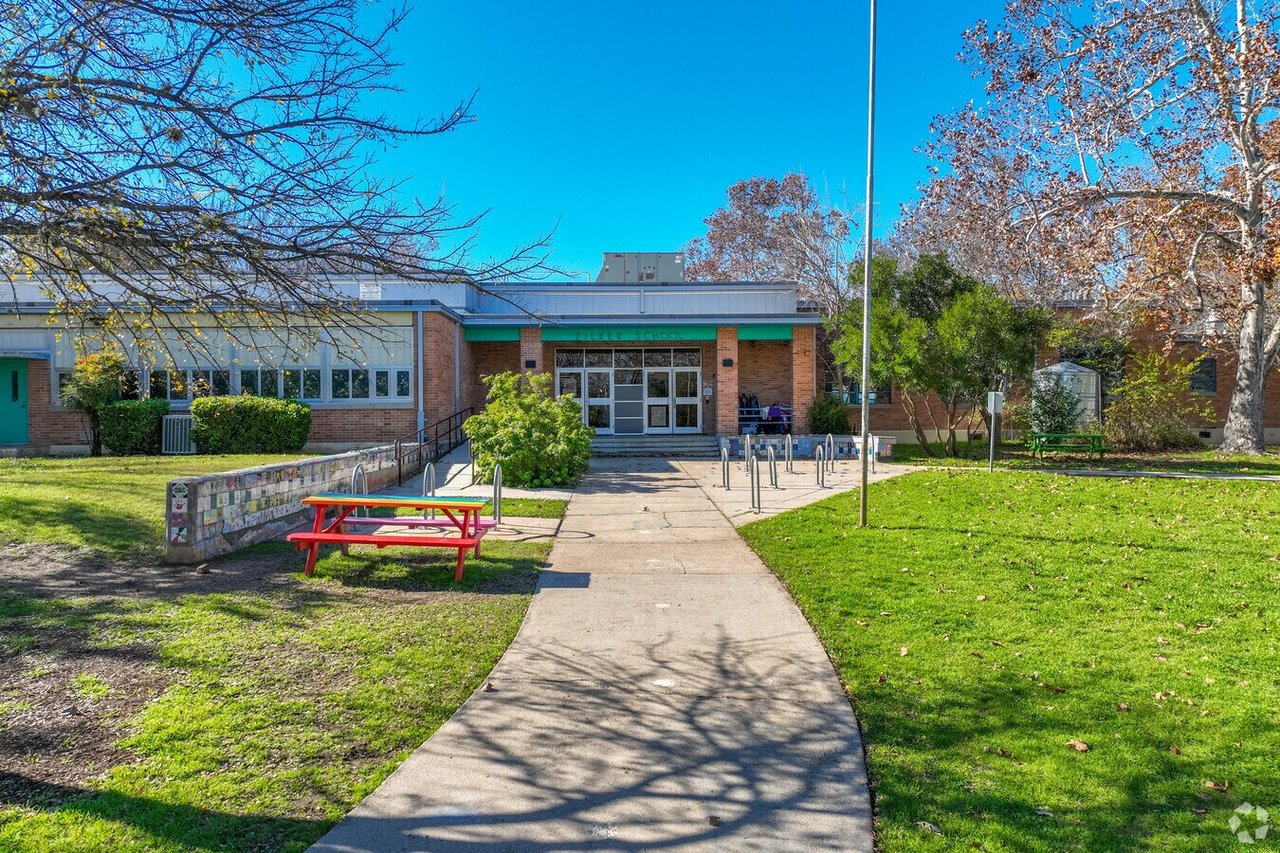
Zilker Elementary
The neighborhood's own campus, and a genuine part of why families stay here rather than trading up and out.
The school's identity leans into where it sits. Its programming emphasizes the arts on and off campus, environmental education, and social and emotional learning alongside academics — which, in a neighborhood organized around a park, a spring-fed pool and a greenbelt, is less a curriculum choice than a natural fit. There's an active PTA, and a partnership with a nearby restaurant supports an edible schoolyard where students grow and maintain a garden.
What that adds up to practically: it's a neighborhood school in the older sense. Kids walk or bike to it. Parents run into each other at the park on weekends. For families who want that texture — and it's increasingly rare in a city this size — it's a real part of the value of living here.
Barton Hills Elementary, immediately next door in the adjacent neighborhood, has a similar character and its own distinct programming. Families comparing Zilker against Barton Hills are generally not choosing between a strong school and a weak one.
Boundary Change Risk Is Real, and Worth Understanding
This is the factor most families never think about until it affects them.
Every October, AISD reviews a ten-year demographic report assessing population growth and decline and housing trends, to determine whether attendance area adjustments should be considered. Historically that work ran alongside a district advisory body drawn from across Austin. Following feedback from recent boundary change processes, the district is currently re-evaluating its procedures — the Boundary Advisory Committee has been dissolved while staff researches a better approach, and details of the replacement process are still being developed. The district has said it will continue incorporating community feedback.
Two takeaways for a buyer. First, boundaries do change, and a school assignment you verify today is accurate today rather than permanently. Second, the process for changing them is itself in flux right now, which makes the current moment less predictable than usual.
None of this should stop anyone from buying in Zilker. It should stop anyone from treating a school assignment as a permanent feature of a property in the way that lot size or zoning is. If a specific campus is genuinely non-negotiable for your family, that's worth a conversation about how much risk you're comfortable carrying — and it's an argument for looking at districts where the whole district is the draw rather than one campus.
The Eanes Question
Every family looking at Zilker eventually runs this comparison, so let's do it honestly.
Eanes ISD is across the bridge, covering Westlake, Rollingwood and the surrounding 78746 area. It has a long-standing reputation and it exerts real gravity on Austin buyers with school-age children. Families who prioritize district-wide consistency over a single campus tend to end up there.
What you're trading to get it:
Zilker (Austin ISD) | Westlake / Rollingwood (Eanes ISD) | |
|---|---|---|
Daily life | Walk or bike to the elementary campus; park and pool at the end of the street | More driving, larger lots, quieter streets |
Lot size | Typically 7,000–7,500 SF — the park serves as the backyard | Generally larger, with room for what a yard is actually for |
Commute | Ten minutes to downtown across the bridge | Longer, and the bridge is the bottleneck at the wrong hours |
Property taxes | Central Austin rates | Meaningfully lower in Rollingwood and Westwood — verify current rates |
The school factor | A strong neighborhood campus, with feeder-path and boundary variability | District-wide consistency is the primary draw |
School assignments, district boundaries and tax rates are set by the relevant districts and taxing entities and change over time. Confirm current information for any specific address before making a decision.
The honest framing: this is not a question of good schools versus bad schools. It's a question of whether you want your child walking to a neighborhood campus in a walkable neighborhood, or whether district-wide consistency and a bigger yard matter more. Both are defensible. Families who pick one and spend years second-guessing usually did it for someone else's reasons.
Weighing central Austin against the west side?
It's the most common fork families hit in this price range, and it rarely comes down to the schools alone. The Davis Agency works both sides — Zilker, Barton Hills, Bouldin and Travis Heights, plus Westlake and Rollingwood — and can lay out the trade honestly.
Private and Program Options
Part of why some Zilker families don't treat the district question as decisive: central Austin has a well-developed private school landscape, and Zilker's location means most of it is reachable without a punishing commute.
Within AISD, specialty programming is also worth investigating rather than assuming. The district offers various program tracks across campuses — dual-language, fine arts, IB at certain schools, gifted and talented, career and technical education. Availability varies by campus and by year, and some programs have their own application processes independent of where you live. If a specific program matters to your family, ask about it directly rather than inferring it from a neighborhood's reputation.
What to Do Before You Write an Offer
Run the exact address through AISD's school finder. Not the neighborhood, not the street, the address. This is the single most important step and it takes two minutes.
Check all three levels. Elementary is the one people verify. Middle and high school assignments are where the surprises live, since those are the levels most likely to split across feeder patterns.
Visit the campus. Ratings aggregate things that may not matter to your child and miss things that do. An hour on site tells you more than any score.
Ask about programs specifically. If dual-language or a fine arts track is the reason you're looking at a campus, confirm it exists there this year and understand how enrollment works.
Don't rely on the listing. Marketing materials repeat what someone was told. The district is the authority, and it's the only one that will still be right in two years.
Frequently Asked Questions
What schools serve Zilker in Austin?
Zilker is served by Austin ISD, with Zilker Elementary located within the neighborhood. Central Austin campuses generally feed through O. Henry Middle School into Austin High. However, AISD determines each student's path by home address rather than by neighborhood, and elementary schools can feed into more than one middle school. Verify assignment for a specific address using the district's school finder.
Is Zilker Elementary a good school?
It's a well-regarded neighborhood campus with programming emphasizing the arts, environmental education, and social and emotional learning alongside academics, supported by an active PTA and an edible schoolyard garden run in partnership with a nearby restaurant. Most families in the neighborhood can walk or bike to it. As with any school, visiting in person tells you more than ratings do.
Does Zilker feed into Austin High School?
Generally yes — central Austin campuses including Zilker typically route through O. Henry Middle School into Austin High. But AISD assigns by individual home address, and the district notes that schools are sometimes split into multiple feeder patterns, meaning an elementary can feed into more than one middle school. Confirm the specific address through AISD rather than relying on a neighborhood-level summary.
Can Austin ISD school boundaries change?
Yes. AISD reviews a ten-year demographic report each October, assessing growth, decline and housing trends to determine whether attendance area adjustments should be considered. The district is currently re-evaluating its boundary change procedures — the Boundary Advisory Committee has been dissolved while staff develops a new approach, with community feedback still part of the process. A verified school assignment is accurate as of today rather than permanent.
Related Reading from The Davis Agency
→ Moving to Zilker: The Complete Guide
→ Zilker vs. Barton Hills: Which One Actually Fits You
Choosing a Neighborhood Around Your Family?
Schools are usually one factor among several, and the households that end up happiest tend to be the ones who were clear about how the whole set ranked before they started touring. The Davis Agency works central Austin and the west side and has since 2006.
Start the ConversationCall (512) 608-8811
Derrik Davis · Broker/Owner, The Davis Agency · CLHMS Certified · TREC License #558841 · Serving 78704 and the greater Austin luxury market since 2006. School attendance zones, feeder patterns, program availability and district boundaries are set by the school districts and subject to change. This article is general information — verify all school assignments directly with the district for any specific address before making a decision.