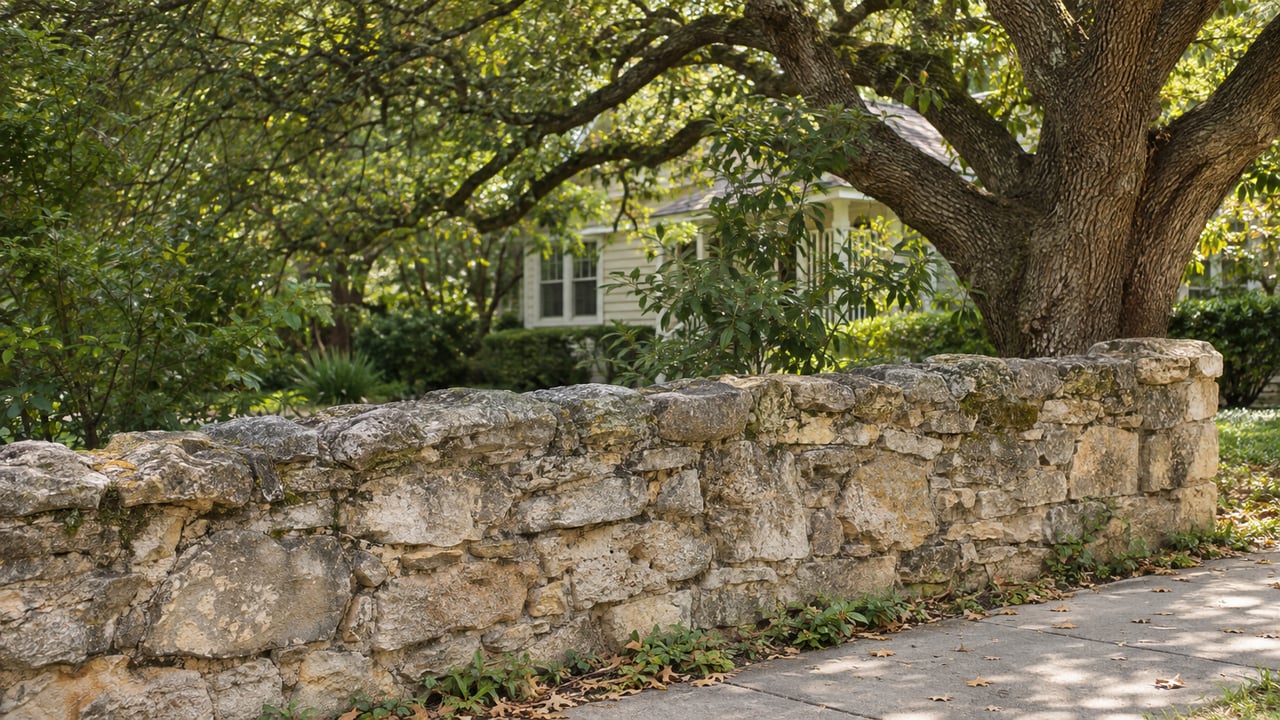
At 1616 Waterston Avenue, a piece of old stone wall is still standing. The Clarksville Community Development Corporation's walking tour brochure identifies it as part of a wall that once ran along the north side of Waterston and marked the edge of Governor E. M. Pease's plantation. On one side was Woodlawn. On the other, Clarksville grew into a freedom colony.
Two programs this month sit on either side of that line. Pease Park Conservancy's guided walk on Saturday, November 21, tells the stories of people the Pease family enslaved on the land that is now the park. Three blocks of Clarksville history away, the Hezikiah Haskell House museum at 1705 Waterston opens to visitors on Sunday, November 15 and Sunday, November 29, and then closes for December. The two programs tell the same story, and the man who connects them is Peter Tucker.
Woodlawn ran right up to the neighborhood's edge
Today's Pease District Park was once part of the 365-acre Woodlawn homestead owned by Governor Pease and his wife, Lucadia. Pease Park Conservancy says research has found that at least 37 people were enslaved by the Pease family or leased to it as enslaved labor, even though the governor supported the Union during the Civil War. In its February 2026 profile of the Haskell House, the Austin American-Statesman puts the number at an estimated 30 to 40 and describes the plantation as covering land west of Shoal Creek.
The Statesman also reports that in 1871, Charles Griffin Clark, a formerly enslaved man from Mississippi, bought two acres from Nathan Shelley, a former Confederate general. That land became the heart of Clarksville. The Pease family gave the creekside land for the park to the city on August 25, 1875. The brochure repeats a legend that after emancipation, Governor Pease gave some of his formerly enslaved workers land in what became Clarksville "for good and loyal service." It adds that many Clarksville residents later worked for the Pease family, and that each Christmas they were invited to a celebration at the mansion on Niles Road.
So the wall stood between two neighbors whose lives stayed connected for decades after slavery ended.
The man who crossed the line
The CCDC's history of the Haskell House says that around 1875, Peter Tucker and his wife paid $100 for land on what is now Waterston Avenue and built a home there sometime between 1879 and 1887. Before that, Tucker had been enslaved at Woodlawn. His house still stands where he built it. It is the oldest documented residence in the Clarksville National Register Historic District, it carries both state and city landmark status, and it belongs to the federal Reconstruction Era National Historic Network.
The building shows how little early Clarksville had to work with. Tucker built it from cedar and mesquite that grew on the site, roofed it with rough-hewn cedar shakes, and gave it only one wall to save money. It has two separate front doors so the household could take in boarders. The original floor plan is unchanged, and a few original windows, some square nails and a sand-mortar brick fireplace are still visible.
The Tuckers sold the house to Mary and Edwin Smith. Mary's brother was Charles Clark, the neighborhood's founder. Mary helped establish Sweet Home Missionary Baptist Church, and before the congregation could afford a building, it held services in the Smiths' home. One of the Smiths' boarders was Hezikiah "Kye" Haskell, a former Union soldier from Baltimore who served as a Buffalo Soldier in an all-Black cavalry regiment on the western frontier. He married the Smiths' daughter, Kate.
One of his descendants runs the museum today. The Statesman profiled Felecia Miller, president of the CCDC, whose third-great-grandfather was Haskell. In the article she recalls that the bell at Sweet Home rang to let people know when someone had passed. "If we had nothing else, we had our faith," Miller told the paper.
The November calendar, both sides of the wall
Taken together, the dates put programs on both sides of the wall across three weekends, and the window closes at the end of the month.
| Date | Program | Where | Details |
|---|---|---|---|
| Sunday, Nov. 15 | Haskell House open | 1705 Waterston Ave. | 1–4 p.m., free, docents on site |
| Saturday, Nov. 21 | Lives Remembered: Black History in Pease Park | Kingsbury Commons, 1100 Kingsbury St. | 10–11 a.m., registration link on event page |
| Sunday, Nov. 29 | Haskell House open | 1705 Waterston Ave. | 1–4 p.m., free, last open date of 2026 |
| December | Haskell House closed | Reopens on its regular schedule after December |
The museum usually opens on the second and fourth Sundays of the month, plus some Saturdays. The CCDC also takes requests for visits outside those hours at [email protected]. Because both programs come from organizers' published schedules, check the Pease Park event page and the CCDC events page before you head out.
What the Pease Park walk covers
The Saturday tour covers about 1.5 miles and is led by guides Donovan and Julia. Meet at the front of the park, by the first Pease Park sign. The Conservancy developed the program with Javier Wallace of Black Austin Tours and Funmi Ogunro of Art is Cool. A City of Austin Heritage Preservation Grant also pays for genealogical research, Freedom Communities celebrations and interpretive signs throughout the park. The Conservancy's May 2026 announcement says the tours run twice a month and share the names and stories of some of the people enslaved by the Pease family.
Some of those names have been public for years. In a 2021 post, the Conservancy named Esther, Celia, "Tom or Tim," Emily and her child, Maria, and Mary Ann. Peter Tucker's name is on a different list, the deed history of a house on Waterston Avenue.
If you can't make the 21st, the Conservancy offers a digital video tour and an audio tour. The audio version is meant for walking the park's eastern trail.
The Clarksville side, stop by stop
The CCDC's printed walking tour is free to pick up at the Haskell House or download. Its stops are close together, so a Sunday afternoon at the museum works as a starting point. In order, the stops tied most closely to the Woodlawn story are:
- Haskell House, 1705 Waterston Ave. Start inside, where a collection of photos traces Clarksville from its early days into the 1980s.
- Charles Clark homestead, 1618 W. 10th St. The founder's land, bought in 1871.
- Elias Mayes homestead, 1620 W. 10th St., and the Ben Mays house, 1624 W. 10th St., the founder's neighbors on the same block.
- Clarksville Park, 1811 W. 11th St. This is the former site of the Clarksville Colored School. The Statesman reports that the park is named for community advocate Mary Frances Baylor.
- Lost Clarksville, looking west toward MoPac. The brochure says the neighborhood once extended past the railroad tracks, and that building the expressway beginning in the late 1960s displaced as many as a quarter of its residents.
- Pease plantation boundary wall, 1616 Waterston Ave. The remnant that marks the old edge of Woodlawn.
- Lawson House, 1106 Toyath St. Built around 1909 by Albert Lawson, a bank porter who later worked at the Crescent and Dunbar theaters. The Lawson family owned it for more than 80 years.
- Sweet Home Missionary Baptist Church, 1725 W. 11th St. The congregation that started in the Smiths' parlor bought this property on July 1, 1882. The current building, its third, was built in 1935 by Clarksville resident W.S. Edmerson.
Most of these stops are private homes or an active church, so view them from the sidewalk. The CCDC schedules guided neighborhood walks for a suggested donation if you'd rather have a docent along.
Why the last Sunday of November matters
Woodlawn is still standing on the other side of the old line. The Statesman describes the two-story Greek Revival house at 6 Niles Road as built by enslaved people under the direction of master builder Abner Cook. The paper reports that the house has been beautifully restored and that its current owner's identity remains a public mystery. The house Peter Tucker built is open to anyone, free, but only until 4 p.m. on November 29 this year.
That gives you a clear plan. Walk the park with the Conservancy on the 21st, then spend the 29th in Tucker's house on Waterston, a short walk from the remnant of the wall that once separated the two.
Houses like the Lawson House carry a city historic designation, and Clarksville's story is written into blocks like Waterston and West 10th. If you own a historic home in Clarksville or are thinking about one, Derrik Davis and The Davis Agency can walk you through what its history means for its value. Get your home valuation & consultation.