Austin Lifestyle · June 2026
Austin's event conversation tends to orbit the same three or four names: SXSW, ACL, Formula 1. The gravitational pull of those events is justified — they are each genuinely significant, each specific to Austin in a way that matters. What gets lost in that orbit is a different category of Austin event: the ones that are excellent, nationally recognized in their industry, and consistently underattended by the residents most likely to enjoy them. Moontower Comedy Festival and Austin Food & Wine Festival belong in that category. Both deserve a longer look than they typically get.
Talk to The Davis AgencySearch Austin Listings
April 8–19 Moontower Comedy 2026 Paramount Theatre + 10+ downtown Austin venues | 2 weeks Moontower's Run Longest-running comedy festival format in Austin | November Austin Food & Wine Festival 3-day event at Auditorium Shores on Lady Bird Lake | 50+ Restaurants & Chefs Participating in Austin Food & Wine Festival annually |
The events that get underattended in Austin are not the ones that lack quality. Austin's event calendar is competitive enough that something genuinely excellent can get lost simply because SXSW and ACL are consuming the available attention in the weeks immediately before and after. Moontower Comedy Festival and Austin Food & Wine Festival are both nationally recognized in their respective industries. Both bring talent to Austin that visitors from other cities specifically travel to see. And both are attended at rates that fall well short of what their programming quality would seem to warrant, simply because they live in the shadows of Austin's larger cultural events.
This guide gives both the space they have earned.
Moontower Comedy Festival: Two Weeks of Something Austin Has Always Had the Audience For
Austin has been a strong comedy market for longer than it has had a comedy festival. The live music culture that built the city's entertainment identity also built an audience that shows up for performance of all kinds, and the specific Austin character — informal, curious, willing to sit with something that doesn't quite work because it might be brilliant — is an audience that stand-up comedy rewards in ways that more reserved cities do not.
Moontower Comedy Festival, presented by The Paramount Theatre in partnership with the Just for Laughs organization — the legendary Montreal-based comedy brand — runs for two weeks in April. The 2026 edition ran April 8–19, with programming split between two distinct formats: the main stage at the historic Paramount Theatre on Congress Avenue, where headliners perform for full theater audiences in a formal sit-down setting, and the Club Series, where tickets rotate attendees through ten or more downtown Austin venues within walking distance of each other over the course of the festival's two-week run.
The 2026 headliners at the Paramount included Marc Maron — whose presence signals the tier of comedian the festival has established as its standard — Leslie Jones, and Kathy Griffin. The headliner tier draws the attention that gets Moontower written about nationally. The more interesting case for the festival, to Austin residents who are deciding whether to attend, is the Club Series: two weeks of programming spread across venues that include the kinds of Austin clubs where the city's comedy scene actually lives, featuring comedians at every career stage from rising national acts to performers who are genuinely not yet famous but are performing at a level that would cost ten times the ticket price in Los Angeles or New York.
The Just for Laughs Partnership: What It Means
Just for Laughs is the Montreal comedy festival that has been the most significant incubator of stand-up comedy talent in North America for decades. Its partnership with Moontower is not merely a branding arrangement — it brings JFL's programming expertise, industry relationships, and talent pipeline to Austin in a way that elevates Moontower beyond what any single city's comedy organization could build independently. The comedians whose careers are made at Just for Laughs in Montreal are often the same comedians appearing in Austin the following year. Moontower is the American satellite of that talent development system, and Austin is where it lands.
The Two-Week Format: Why It Works Differently Than a Weekend Festival
Most comedy festivals compress their programming into a single weekend, which produces a density of shows that rewards the attendee who plans exhaustively and punishes the one who wants to attend casually. Moontower's two-week format distributes the programming across twelve days in a way that allows Austin residents to attend one or two shows without committing to a festival-weekend schedule. This is a meaningful structural difference: it makes Moontower accessible to people who like comedy and want to see a few shows, rather than exclusively to people who are treating the festival as a dedicated event.
The Paramount Theatre main stage shows require advance planning and tickets at the headliner tier — these sell out quickly and the Paramount's 1,300-seat capacity is genuinely limited. The Club Series shows are more accessible, with tickets available closer to showtime and venues that range from 100 to 400 seats depending on the club. The informal atmosphere of the Club Series — where the performer might be testing material or trying a new set structure or working through a character that is not yet fully realized — is the specific kind of show that comedy fans remember years later as the best thing they saw.
Why Moontower Is Worth Putting on Your Calendar
The case for Moontower attendance is partly about the talent — the headliners are consistently at the Marc Maron level, which is to say genuinely excellent and at a price point that would be higher in any coastal market — and partly about the specific experience of seeing live comedy in Austin venues during a two-week festival.
Austin's comedy scene has grown significantly in recent years, and Moontower both reflects and accelerates that growth. The local Austin comedians who perform in the Club Series are performing alongside national acts in a way that creates an unusual programming mix: the attendee who sees a well-known headliner on Thursday and a genuinely surprising local act on Saturday has had a richer festival experience than the one who only attended the main-stage programming. The mix is what Moontower does best and what distinguishes it from a simple touring comedy show.
Austin Food & Wine Festival: The Best Food Weekend in Austin's Annual Calendar
The Austin Food & Wine Festival moved from its traditional spring slot to November several years ago, settling into the first weekend of November at Auditorium Shores on the north shore of Lady Bird Lake. The timing is not incidental: early November in Austin delivers some of the year's best outdoor weather — warm enough for a comfortable afternoon at an outdoor festival, cool enough that standing in the sun for three hours is an experience rather than an ordeal. The festival's setting, with the Austin skyline framing the south side of Lady Bird Lake while the tents and stages fill the Auditorium Shores grounds, is among the most visually distinctive of any food festival in the country.
The 2025 festival ran November 7–9, with 2026 planned for early November. Weekend passes run approximately $280; single-day tickets around $205; VIP packages around $750 that add a Friday evening event, early entry, dedicated lanes, and lounge access. All food and beverage sampling is included in the ticket price. The festival is 21-and-over.
What the Three-Day Experience Looks Like
Austin Food & Wine Festival is built around three programming formats that run across the weekend and that together constitute one of the more comprehensive culinary event experiences available in the American Southwest.
The tasting tent. More than 50 Austin and national restaurants participate, with chefs and staff serving tastings from stations arranged across the Auditorium Shores grounds. The lineup includes Austin's most celebrated restaurants alongside national names whose Austin presence is specifically driven by the festival. The tasting tent is where most attendees spend most of their time: moving through stations, collecting tastings, pausing at conversations with the chefs and restaurant teams who are genuinely present rather than represented by junior staff.
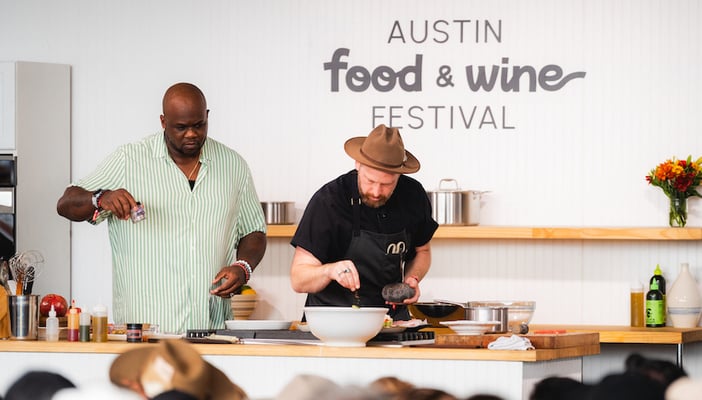
Chef demonstrations. The demonstration programming brings chefs from Austin and nationally to a main stage for cooking demonstrations that range from technique instruction — the kind of knife skills or reduction method that a home cook can actually take home — to dish construction that is primarily visual and aspirational. The demonstrations are free to attend with general admission and run throughout the day across both Saturday and Sunday. The most popular demonstrations sell out their viewing areas quickly; arriving early or consulting the schedule in advance is the practical move.
Tasting sessions. Guided tastings led by master sommeliers, certified specialists, and distillery and winery representatives run as ticketed sessions throughout the weekend. The sessions cover wine, spirits, beer, and non-alcoholic beverages from 30+ producers participating in the festival. VIP ticket holders access the sessions with priority entry; general admission holders can attend available sessions on a first-come basis. The session format — a guided progression through a specific category of beverage with expert commentary — is the programming element that most clearly distinguishes Austin Food & Wine from a simple food and drink outdoor event.
Considering Austin and want to know what it's actually like to live here?
Moontower and Austin Food & Wine are two of the reasons Austin residents feel they live in a city that takes its cultural life seriously. The Davis Agency works with buyers who are choosing Austin specifically — and the neighborhood guide matters as much as the event calendar.
What Austin Food & Wine Festival Says About Austin's Restaurant Scene
Austin's restaurant scene has undergone a genuine transformation over the past fifteen years. The city that was primarily known for barbecue, Tex-Mex, and the food trailer culture that emerged in the mid-2000s has developed into one of the more serious restaurant markets in the country — with James Beard Award nominations and wins appearing annually, with multiple nationally recognized fine dining establishments operating across the central Austin neighborhoods, and with the kind of depth in ingredient sourcing and culinary technique that sustains a serious restaurant community rather than just a few celebrated destinations.
Austin Food & Wine Festival is both a reflection and a cause of that transformation. The festival's reputation for showcasing national culinary talent alongside Austin's best chefs has helped establish Austin's standing in the national food conversation — a conversation that increasingly treats Austin as a destination city for serious food travel rather than as a secondary market where good restaurants can occasionally be found. The 50+ restaurants and 30+ beverage producers who participate each year represent a supply of culinary talent that would not have existed in Austin twenty years ago.
For residents who are embedded in the Austin food community — who follow the restaurant openings, who know which chefs have moved between kitchens, who track the barbecue scene and the natural wine lists and the specific South Congress establishments that have developed national profiles — Austin Food & Wine Festival provides three days of concentrated access to that community in a single space. For residents who are less embedded but who enjoy excellent food and drink in a beautiful outdoor setting, the festival's tasting tent format provides one of the more accessible entry points into Austin's culinary world.
The Scale Question: Why These Two Events Get Overlooked
The honest reason that Moontower Comedy and Austin Food & Wine Festival attract less attention than their quality warrants is scale. Neither event produces the transformative city-level impact that SXSW or ACL or Formula 1 delivers. The hotel pricing does not surge. The out-of-town visitor volume is not large enough to change the character of downtown. The national media coverage is real but modest compared to what Austin's signature events generate.
This is, in a specific sense, a feature rather than a limitation. Both events are attendable on the day of the event, without six-month advance planning, without hotel pricing multiples, without the logistical compression that accompanies the city's largest gatherings. A couple who decides on a Wednesday that they want to see a Moontower Club Series show on Saturday can likely make that happen with a same-week ticket purchase. A group of friends who decides in October that they want to attend Austin Food & Wine Festival can find tickets, plan transportation, and attend without the experience of competing with 430,000 other people for the same space.
The accessibility is what makes both events good choices for Austin residents who enjoy cultural programming but whose relationship with the city's signature events has calcified into the familiar routine of managing logistics rather than attending them. Moontower and Austin Food & Wine are the events where showing up is still the main thing required.
The Case for Showing Up
Austin's event calendar is dense enough that residents have to make choices about what to attend and what to experience as background city energy. Moontower Comedy Festival and Austin Food & Wine Festival are the events where the choice to show up is most consistently rewarded — where the programming is excellent, the audience is genuinely engaged, and the experience is specific to Austin in a way that does not depend on the city being overwhelmed by visitors to produce it. They are the events that residents most often describe as the ones they wished they had been attending all along.
Frequently Asked Questions
Do I need to buy Moontower tickets in advance or can I get them at the door?
For Paramount Theatre headliner shows: buy in advance. The 1,300-seat capacity fills quickly and the headliner-tier shows consistently sell out before the festival opens. For Club Series shows: advance purchase is recommended but same-week availability is often possible, especially for shows at smaller venues during the first week of the festival when the larger audiences haven't yet arrived for the headliner weekend. Check austintheatre.org/moontower-comedy for the current lineup and ticket availability.
Is Austin Food & Wine Festival worth the ticket price compared to just visiting Austin restaurants?
The honest comparison: a weekend pass at approximately $280 provides access to 50+ restaurants and 30+ beverage producers across three days, with all food and beverage included. The equivalent Austin restaurant spending across three meals per day from comparable restaurants would significantly exceed that figure. The festival's value proposition is primarily density and access — the ability to encounter fifty restaurants in one weekend, including some that are beyond the typical dining-out price point, with no per-item additional cost. For food-focused visitors or residents who specifically want a concentrated culinary weekend, the pass represents good value. For casual food enjoyers who are happy with their usual Austin restaurant rotation, the ticket price may be harder to justify.
What is the Austin comedy scene like outside of Moontower?
Austin has a genuine year-round comedy scene centered primarily on a handful of clubs and bars that program live stand-up consistently: The Creek and The Cave, Cap City Comedy Club, Esther's Follies (sketch and variety), and the informal shows at various bars across the Red River Cultural District and East Sixth Street corridors. The Moontower period is the annual moment when the national comedy industry's attention turns to Austin, but the local scene that Moontower accelerates exists independently of the festival and is available to Austin residents who want it throughout the year.
What should I prioritize if I can only attend one day of Austin Food & Wine Festival?
Saturday tends to be the most fully programmed day of the festival, with chef demonstrations and tasting sessions running throughout the afternoon and the tasting tent at its most active. If Saturday is unavailable, Sunday offers comparable programming with slightly smaller crowds by the afternoon. Friday (for VIP ticket holders who access the Friday evening event) provides the most intimate access to the festival's talent before the full weekend crowds arrive. For a single-day general admission attendee, Saturday is the day that delivers the complete festival experience most reliably.
Related Reading from The Davis Agency
→ Austin's Annual Events Calendar: The Cultural Moments That Define Life in the City
→ SXSW: What Austin's Most Important Week Actually Means for the City
→ ACL 2026: A Complete Guide to Austin's 25th Anniversary Music Festival
→ Inside Bouldin Creek: A Neighborhood Character Guide for Luxury Buyers
→ South Congress as a Real Estate Asset: How SoCo Proximity Drives Property Values
Looking for a Home in the City That Has All of This?
Moontower Comedy and Austin Food & Wine are two of the quieter arguments for why Austin's cultural life is what it is. If you are evaluating Austin as a place to live and want to understand what the day-to-day and year-round experience actually looks like, The Davis Agency is the right conversation.
Search Current Listings Call (512) 608-8811
Or email [email protected]. Derrik responds personally.
Derrik Davis · Broker/Owner, The Davis Agency · CLHMS Certified · TREC License #558841 · Serving Austin's luxury market since 2006.