Investor & Homeowner Guide · May 2026
The 2023 HOME Initiative fundamentally rewrote Austin's ADU rules — and 78704 homeowners are sitting on some of the most valuable ADU sites in the city. Central location, strong rental demand, and lot characteristics that lend themselves to well-designed backyard units make Barton Hills, Zilker, Bouldin Creek, and Travis Heights a natural fit for the ADU investment thesis. Here is the full economic picture.
Call (512) 608-8811 Get a Property Assessment
| Up to 2 ADUs Per Lot Now Austin HOME Initiative, 2026 | $150K–$350K 78704 ADU Build Cost Depending on size and type | $2,000–$3,500 Monthly Rental Range 78704 long-term rental, 2026 | 30 days Max STR Per Year ADUs built after Oct 2015 |
Austin added more than 1,200 ADU permits in the two years following the HOME Initiative's passage in December 2023 — a 340% increase over the prior two-year period. That surge is not noise. It reflects homeowners and investors recognizing that ADUs have shifted from a nice-to-have to a financially meaningful strategy, particularly in high-rent submarkets like 78704 where the location premium makes small square footage highly rentable.
This post covers the full economics — what the rules allow, what construction actually costs, what the rental income looks like, and what the ROI scenarios tell you about whether an ADU makes financial sense for a specific 78704 property.
What Changed: The HOME Initiative and What It Means for 78704
Before December 2023, ADUs in Austin were permitted in SF-3 zones, subject to owner-occupancy requirements, and limited to one per lot. The HOME Initiative changed all of that in one vote. Here is what the rules look like now:
| Rule | Before HOME Initiative | Current (2026) |
|---|---|---|
| Zoning eligibility | SF-3 only | SF-1, SF-2, SF-3 — most residential lots in 78704 |
| Units per lot | 1 ADU maximum | Up to 2 ADUs per lot (significant change) |
| Owner occupancy | Required | Not required — rent out both primary and ADU |
| Minimum lot size | 5,750 SF | 2,500 SF (opens many more 78704 lots) |
| Max ADU size | 1,100 SF | 850–1,100 SF depending on lot size |
| Parking requirement | 1 additional space | No additional parking required |
For 78704 specifically, the combination of lower minimum lot size (2,500 SF opens up many Bouldin Creek lots that previously could not qualify) and the two-ADU allowance creates meaningful new opportunity. A Bouldin Creek homeowner with a 5,500 SF lot who previously had one ADU option now potentially has two — which changes the economics significantly for investors evaluating yield on 78704 assets.
ADU Size Rules: What the Numbers Actually Mean
The maximum permitted ADU size in Austin is tied to your lot area:
Lots under 5,750 SF: ADU up to 850 SF. This covers a significant number of Bouldin Creek and Travis Heights lots — enough space for a well-designed 1-bedroom or studio unit.
Lots 5,750–7,000 SF: ADU up to 1,000 SF. Covers many Zilker and Bouldin Creek lots — room for a comfortable 1-bedroom or compact 2-bedroom unit.
Lots over 7,000 SF: ADU up to 1,100 SF. Covers most Barton Hills lots — enough for a true 2-bedroom unit that commands the upper end of the rental range.
Additional constraints: if the ADU includes a second story, the upper floor cannot exceed 550 SF and total height must stay under 30 feet. The ADU also cannot exceed the primary dwelling's square footage. Setbacks are 5 feet from rear and side property lines. Impervious cover limits still apply, which is the variable most likely to constrain ADU scope on lots where the primary home has already used a significant portion of the allowable coverage.
The Impervious Cover Check Is Critical
Before you get excited about an ADU's income potential, verify the impervious cover remaining on your specific lot. A property where the primary home has already used 40% of a 45% impervious cover limit has very limited room for a new footprint. Run this calculation — or have someone run it for you — before you engage an architect or contractor. It is the most common early-stage disappointment in Austin ADU planning.
The Three ADU Types Worth Knowing
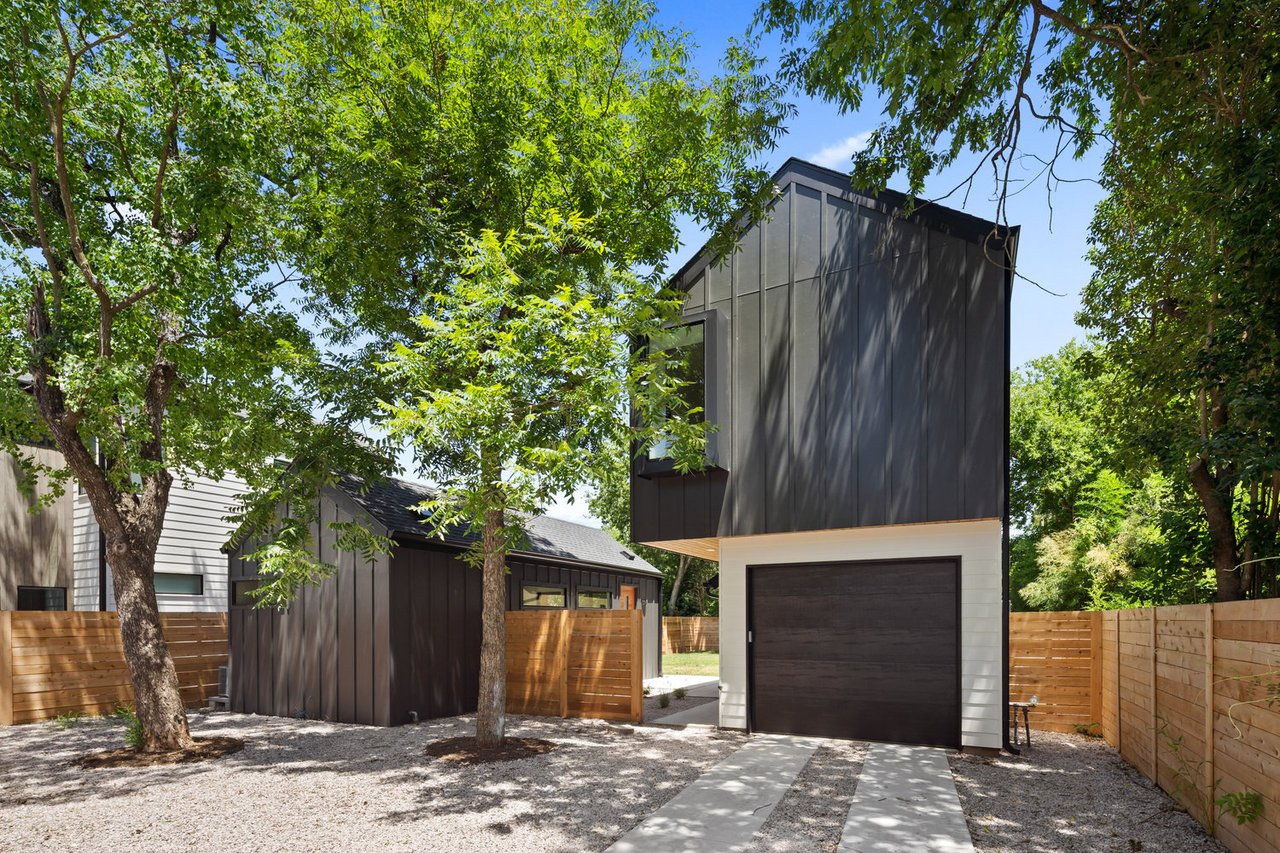
Detached ADU (DADU) — the backyard cottage. A standalone structure in the rear yard, with its own foundation, roof, and utilities. Maximum privacy and rental appeal, but highest construction cost. This is the type that generates the strongest rental income in 78704 because tenants value the separation from the primary residence. Best suited to lots with rear alley access, which is common in Bouldin Creek and parts of Travis Heights.
Garage conversion. An existing detached garage converted to living space. Lowest construction cost because the shell and some infrastructure already exist — typical range is $50,000–$120,000 depending on scope and condition of the existing structure. The trade-off is loss of garage parking, which affects the primary home's functionality and in some cases its resale value. Best suited for properties where the garage is underutilized and the household does not depend on covered parking.
Attached ADU / internal conversion. A portion of the primary home converted to a separate unit — basement conversion, first-floor suite, or addition with a separate entrance. Construction cost varies widely based on scope. Less privacy than a detached unit, but potentially the most cost-effective path if the existing structure has underutilized space that can be converted without major structural work.
What It Actually Costs to Build: The 78704 Reality
ADU construction costs in Austin run across a wide range depending on type, size, finish level, and site conditions. Here is what the current market looks like for 78704 projects:
| ADU Type | Typical Size | Construction Cost Range | Notes |
|---|---|---|---|
| Garage conversion | 400–600 SF | $50,000–$120,000 | Existing shell reduces cost; condition-dependent |
| Attached ADU / conversion | 400–700 SF | $80,000–$200,000 | Scope depends heavily on existing structure |
| Detached new build (studio/1BR) | 400–600 SF | $150,000–$240,000 | Own foundation, utilities — alley access helps |
| Detached new build (1–2BR) | 700–1,100 SF | $240,000–$350,000+ | Full-spec luxury finish; commands top rental |
For 78704 specifically, the cost of a detached ADU tends to land at the higher end of the national range because Austin construction labor and material costs are elevated relative to most Texas markets, and because 78704 owners who are investing in an ADU typically want a quality that matches the neighborhood character rather than a minimum-viable build. A well-designed backyard cottage in Barton Hills or Zilker — with proper insulation, quality finishes, and a design that reads as intentional rather than tacked-on — commands significantly stronger rents than a low-spec build on the same lot.
Add soft costs to those construction figures: architecture and design ($8,000–$20,000), City of Austin permits ($3,000–$8,000), and any utility connection fees that apply. Total all-in investment for a well-executed detached 78704 ADU typically runs $165,000–$380,000.
What ADUs Generate: Rental Income in 78704
The rental income side of the 78704 ADU equation is where the location premium becomes financially tangible. A 600 SF well-designed detached ADU in Barton Hills or Zilker commands meaningfully more than a comparable unit in a less central Austin neighborhood — because the renter is paying for the same location premium that drives the main home's value.
| ADU Configuration | Monthly Rent Range | Annual Income | Notes |
|---|---|---|---|
| Studio / efficiency (400–450 SF) | $1,800–$2,200 | $21,600–$26,400 | Alley access + quality finish required |
| 1 BR / 1 BA (550–650 SF) | $2,200–$2,800 | $26,400–$33,600 | Strongest demand in 78704 ADU market |
| 2 BR / 1–2 BA (850–1,100 SF) | $2,800–$3,500 | $33,600–$42,000 | Premium lot position + quality finish |
These rental rates reflect current 78704 market conditions for long-term leases (30+ days). The 1-bedroom configuration at 550–650 SF consistently delivers the strongest combination of rental demand, construction cost efficiency, and net yield — which is why it is the most common ADU investment choice among 78704 homeowners who have run the numbers carefully.
The ROI Analysis: Two Scenarios
Using the figures above, here is what the economics look like for two realistic 78704 ADU scenarios.
Scenario A — Bouldin Creek Garage Conversion (Studio, $95K All-In)
| Total all-in investment | $95,000 |
| Monthly rent (studio) | $2,000 |
| Annual gross rental income | $24,000 |
| Annual expenses (vacancy, maintenance, insurance) | ~$3,600 |
| Annual net income | ~$20,400 |
| Gross yield on investment | 25.3% |
| Break-even on construction cost | ~4.7 years |
Scenario B — Barton Hills Detached 1BR Cottage ($270K All-In)
| Total all-in investment | $270,000 |
| Monthly rent (1BR/1BA) | $2,600 |
| Annual gross rental income | $31,200 |
| Annual expenses (vacancy, maintenance, insurance) | ~$4,700 |
| Annual net income | ~$26,500 |
| Gross yield on investment | 11.6% |
| Break-even on construction cost | ~10.2 years |
Scenarios are illustrative based on current 78704 market conditions. Actual results vary by specific property, unit quality, management approach, and rental market conditions at the time of lease-up.
The comparison between the two scenarios reveals the classic ADU trade-off: the lower-cost conversion produces a dramatically better yield percentage (25.3% vs. 11.6%) but generates less absolute annual income ($20,400 vs. $26,500). The right choice depends on your capital availability, your primary motivation (maximizing yield vs. maximizing income), and what your specific lot and existing structure support.
Want to know if your 78704 property qualifies for an ADU?
The Davis Agency runs site-specific assessments for 78704 property owners — covering impervious cover availability, lot configuration, and what the rental income potential looks like before you commit to the project. No cost, no obligation.
Get a Property Assessment →The Short-Term Rental Question: What the Rules Actually Say
This is the section that surprises most 78704 homeowners who are considering an ADU as an Airbnb opportunity — so it is worth being direct about what the regulations actually permit.
If your ADU was built after October 1, 2015, Austin's short-term rental ordinance limits its use as a short-term rental to a maximum of 30 days per calendar year. Not 30 days at a time — 30 days total across the entire year. A year-round Airbnb operation in a post-2015 ADU is not permitted under current Austin code.
Starting July 1, 2026, the City of Austin has begun enforcing STR licensing requirements on platforms like Airbnb and Vrbo, requiring all listings to display a city-issued permit number. The enforcement is becoming real, not theoretical — unlicensed STR properties are being removed from platforms at the city's request.
The practical implication: the 78704 ADU investment thesis works on long-term rental income, not short-term rental premium. Fortunately, the long-term rental market in 78704 is strong enough that you do not need the STR premium to make the numbers work. A well-positioned 78704 ADU on a long-term lease generates consistent income without the management overhead, vacancy risk, or regulatory exposure of short-term rental operations.
The Property Value Upside: ADUs and Resale
Beyond the rental income, a well-executed ADU adds measurable value to a 78704 property at resale. Appraisers are increasingly accounting for ADU income potential in their analyses, and buyer demand for properties with existing income-producing units has grown as more buyers factor carrying cost offsets into their purchase decisions.
The value add from an ADU is not dollar-for-dollar on construction cost — a $250,000 ADU does not typically add $250,000 to the property's market value independently. But it does add a meaningful premium, particularly in a market like 78704 where the scarcity of rental inventory near Barton Springs and the Greenbelt makes a proven income-producing unit a genuine differentiator in a competitive resale.
For sellers, a well-documented rental history on an existing ADU — occupancy rate, monthly rent, tenant profile — is the most persuasive possible evidence of the unit's value to a buyer who is evaluating the income offset against their carrying costs.
The 78704 ADU Thesis in One Paragraph
78704 is one of Austin's best ADU markets because the location premium applies equally to rental demand as it does to ownership demand. A tenant paying $2,600/month for a 1BR cottage within walking distance of Barton Springs and South Congress is paying for the same irreplaceable location that makes the primary home valuable. The ADU investment does not require speculative assumptions — it is income backed by the same fundamental demand that drives one of Austin's strongest luxury real estate submarkets.
Frequently Asked Questions
Do I need to live on the property to rent out an ADU in Austin?
No. Austin eliminated the owner-occupancy requirement in 2015. You can rent out both your primary home and your ADU, or rent the ADU while living in the primary home, without any owner-occupancy restriction. This applies to long-term rentals — the 30-day STR limit still applies to short-term rental use of post-2015 ADUs regardless of whether the owner is on-site.
Can I build an ADU if my lot has heritage trees?
Potentially yes, depending on tree location and the buildable envelope remaining after setbacks and tree protection zones are applied. Austin's heritage tree ordinance can constrain ADU placement on lots with significant trees in or near the rear yard. A tree survey and arborist assessment should be part of the early feasibility analysis before you commit to an ADU design or hire a contractor.
How long does it take to get an ADU permitted in Austin?
The City of Austin currently processes ADU permits in approximately 6–10 weeks for straightforward projects. Projects requiring heritage tree reviews, variance requests, or coordination with environmental overlays take longer — sometimes 4–6 months. Building permit timing should be factored into your project timeline and your carrying cost calculation before construction starts.
Does adding an ADU affect my property taxes?
Yes — the ADU adds assessed value to the property, which increases the property tax bill. The magnitude depends on the appraised value the Travis Central Appraisal District assigns to the new structure. Budget for a moderate property tax increase in your net income calculations — typically $2,000–$5,000 annually depending on the ADU's assessed value and the current effective tax rate.
What is the financing path for an ADU construction project?
Several options are available: a cash-out refinance on the primary home if equity supports it, a home equity loan or HELOC, or a construction loan specific to the ADU project. The financing structure affects your all-in cost through interest rate and draw schedule. For homeowners with significant equity in a 78704 property — which includes most long-term holders in this submarket — the cash-out refinance is often the most efficient path if the blended rate on the refinanced balance is reasonable relative to the rental yield the ADU will generate.
Related Reading from The Davis Agency
→ How Infill Development is Reshaping South Austin: A Street-by-Street Look at 78704
→ The 78704 Land Value Report: What Infill Lots Are Actually Worth in 2026
→ The Real ROI on Luxury Spec Builds in 78704: What the Numbers Actually Say
→ Due Diligence Before You Buy a Lot in Austin: The Developer's Pre-Acquisition Checklist
→ What Does It Actually Cost to Build a Custom Luxury Home in 78704 in 2026?
Find Out If Your 78704 Property Qualifies
The ADU conversation starts with a property-specific feasibility check — impervious cover, lot configuration, impervious cover availability, and what the rental income potential realistically looks like. The Davis Agency runs these assessments for 78704 owners at no cost.
Request a Property Assessment Call (512) 608-8811
Or email [email protected]. Derrik responds personally.
Derrik Davis · Broker/Owner, The Davis Agency · CLHMS Certified · TREC License #558841 · Serving 78704 and the greater Austin luxury market since 2006.