The City of Austin's term sheet for the Muny deal includes a sentence about the 190 acres UT keeps along Lake Austin Boulevard, in the section on standards for non-UT projects. It reads, "The University understands that the FAR for sites developed later may be less than .6:1 or may be undevelopable because of the FAR limitation as it is applied to the entire area."
That line sits in the proposed amendments to the Brackenridge Development Agreement, the 1989 interlocal agreement that governs how the University of Texas can use its land on both sides of Lake Austin Boulevard. City Council is scheduled to take it up on November 19. The headline is that Lions Municipal Golf Course would finally belong to the City. The deal works because the City pays in development rights instead of dollars, and for non-UT projects those rights come from one shared pool, so sites developed later can find less of it left.
The City is buying a golf course with development rules
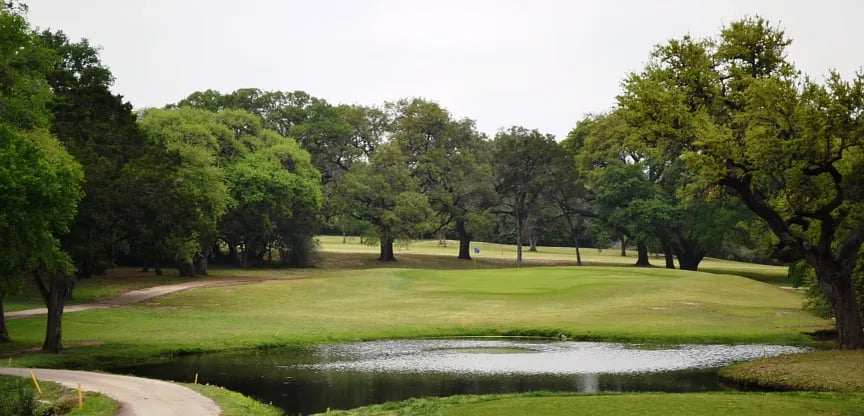
Muny opened in 1924 on more than 140 acres of University-owned land along what is now Lady Bird Lake. The City took over the lease in 1937, and in 1950 Muny became the first public golf course in the South to integrate. It is listed on the National Register of Historic Places as a civil rights landmark and hosts more than 75,000 rounds a year, which makes it Austin's most-used public course. Since 2019 the City has run it on a month-to-month lease from UT. Community Impact reported that the annual lease payment is just under $500,000 and that the 155-acre Muny and West Austin Youth Association property was appraised at more than $680 million.
The City has no way to write a check that size. At the Environmental Commission briefing, City attorney Trish Link said the City was moving because it feared losing Muny and could not afford an outright cash purchase, as Austin Current reported. At the Planning Commission briefing, staff said donated funds would buy the course, not City money. Muny Conservancy co-chair Scotty Sayers told the Austin American-Statesman that anonymous donors are offering a very large gift to UT for its students and campus. In exchange, Muny goes to the City as an 18-hole course in perpetuity. Groundbreak reported that the donors remain anonymous and the gift amount undisclosed.
The donor money covers the golf course. The rest of the package is where UT gets paid.
Party | Gives | Gets |
|---|---|---|
UT | About 141 acres of Muny, conveyed "for use as a golf course"; replacement of existing affordable student housing, on or off site; utility relocation costs for vacated streets | A donor gift; updated standards for 190.26 retained acres; vacated City rights-of-way; a revised Mueller lease allowing residential, childcare and some non-University uses |
City of Austin | New development standards; a tax increment reinvestment zone to fund infrastructure; street right-of-way | Ownership of Muny |
West Austin Youth Association | Nothing in the published terms | Its campus, conveyed separately |
The clause that makes timing matter on 190 acres
The amendment's development standards are written "As Applied to Non-UT Projects," and for those projects they set one shared cap. Floor-area ratio for the whole 190.26 acres would be 0.6:1. The current agreement sets it at .4:1 to .45:1, and the staff comparison prints that as 1.7 million square feet of total gross area. River, tributary and boulevard setbacks shrink the buildable land, so any single site can go above 0.6:1, up to 5:1 without a Council rezoning.
Under that cap, density one non-UT project uses comes out of the same 190-acre total. The term sheet says sites developed later may get less than 0.6:1 or be undevelopable, and that the City is "not responsible for resolving any disputes that may arise due to a lack of remaining FAR." That makes the sequence of development a pricing variable for the land itself. A site developed early draws on a full pool, and a site developed late draws on what remains.
The regulating plan, which comes later, will mirror the amended agreement, and no development sequence exists yet. Per Community Impact, UT has not determined its development plans.
What Lake Austin Boulevard would be allowed to become
The tract today holds UT housing, the Brackenridge Field Laboratory, youth sports fields and commercial buildings, with frontage on both sides of the boulevard. The Brackenridge Apartments would stay for the near future and could be relocated or rebuilt once redevelopment starts. City staff told the Planning Commission that the Gateway Apartments on West Sixth Street are not part of this agreement.
Standard | Current agreement | Proposed amendment, non-UT projects |
|---|---|---|
Floor-area ratio | .4:1 to .45:1 | 0.6:1 shared across 190.26 acres; up to 5:1 per site |
Multifamily density | 22 units per acre | No limit |
Height | Range by tract | 65 ft on and north of the boulevard; up to 105 ft south of it on sites that don't front it |
Impervious cover | 30% to 90% by tract | 75% overall, 85% per site, transferable between sites; 45% on single-family-only sites |
Waterways | 200-ft Lady Bird Lake setback | Same 200-ft setback, plus 50 ft on each side of the minor waterway |
Review | Outside standard City processes | Standard City development review |
The proposed uses include multifamily and other housing, offices, general retail, restaurants, hotels, research and life sciences, some light and custom manufacturing, agriculture, parks and civic uses, with separate lists for the north and south sides of the boulevard. The 65-foot limit is measured from the boulevard, and buildings can still use the city code's standard height-limit exception. Compatibility rules apply north of the boulevard, the side that faces Tarrytown's streets.
Infrastructure has the same shared-cost logic as the floor-area cap. Staff describe the area as mostly undeveloped, without sidewalks, water and wastewater lines or drainage, and with inadequate street layouts. The TIRZ would pay for those improvements, which also covers the City's existing obligation under the 1989 agreement to fund infrastructure there. Infrastructure requirements, cost estimates and reimbursement timing are still being worked out between City and UT staff. The zone has to comply with the City's affordable housing policy, but the term sheet says that housing does not have to be built inside the zone.
What the October briefings added
With the density, height and uses on the table, the two October commission briefings focused on what the term sheet leaves open. Environmental Commission speakers raised the 82-acre field lab, cumulative environmental effects, traffic and the short review window, and some asked for explicit field-lab protections. The Daily Texan reported that the amendments could permit non-University development on field lab land that was previously limited to University use.
Staff also said the 200-foot lakeside setback would not automatically become City parkland. It could, if UT chose that use, but the City has no way to require it. At the Planning Commission, the West Austin Neighborhood Group said there is broad community support for transferring Muny and the youth association campus. The group also asked for field-lab protection, riverfront setbacks, traffic analysis and room for existing local businesses. Holly Reed, who sits on the boards of both the neighborhood group and the Muny Conservancy, told KUT, "I want a thoughtful plan."
Two votes, months apart
The November vote and the spring decisions settle different things.
- November 19, 2026. Council takes up the amended agreement, which includes the Muny conveyance, the shared floor-area cap, heights, uses and the general process for the TIRZ and regulating plan.
- Between November and spring. City and UT staff draft the regulating plan and the TIRZ.
- Spring 2027. Those pieces go through boards and commissions and back to Council. The conveyance of Muny is scheduled for the same period.
Golf continues while all of this moves. The City still runs Muny under its month-to-month lease, and no change to operations has been announced. The Muny Conservancy supports preserving all 18 holes and is urging residents to contact Council before the November vote.
Where this matters on a Tarrytown address
For a buyer weighing Tarrytown, the November vote is the first approval step for both halves of the deal, a City-owned golf course and looser development rules along the boulevard. The conveyance, regulating plan and TIRZ still follow in spring 2027. Three details from the terms are most useful when looking at a home near the tract:
- Which side of the boulevard. North of Lake Austin Boulevard, where the tract meets Tarrytown, heights cap at 65 feet and compatibility rules apply. The 105-foot allowance applies only south of the boulevard, on sites that don't front it.
- Which parcels develop first. Because of the shared floor-area cap, non-UT sites developed early draw on the full pool, and later sites may get less.
- What the TIRZ builds. It is meant to pay for sidewalks, water and wastewater lines, drainage and street improvements on a tract that lacks them, with requirements and costs still being worked out.
FAQ
Will Muny close or change before the transfer? The City still runs the course under its month-to-month lease, and no operational changes have been announced. The conveyance is scheduled for spring 2027.
Is the land along Lady Bird Lake becoming a park? The 200-foot lakeside setback stays, but staff said it would become City parkland only if UT chose that use.
Does the deal include student housing? UT would replace its existing affordable student housing, on or off the Brackenridge property. The Brackenridge Apartments stay for now.
This post is general information about a proposed public agreement and is not legal, tax or financial advice. If you're making a decision about a specific property, confirm the details with the right professional.
At The Davis Agency, we follow entitlement decisions like this one because they change what a lot is worth well before anything is built on it. If you own or are considering a home near Lake Austin Boulevard and want to understand how the Brackenridge terms could affect it, get your home valuation and consultation with Derrik before the spring 2027 votes.