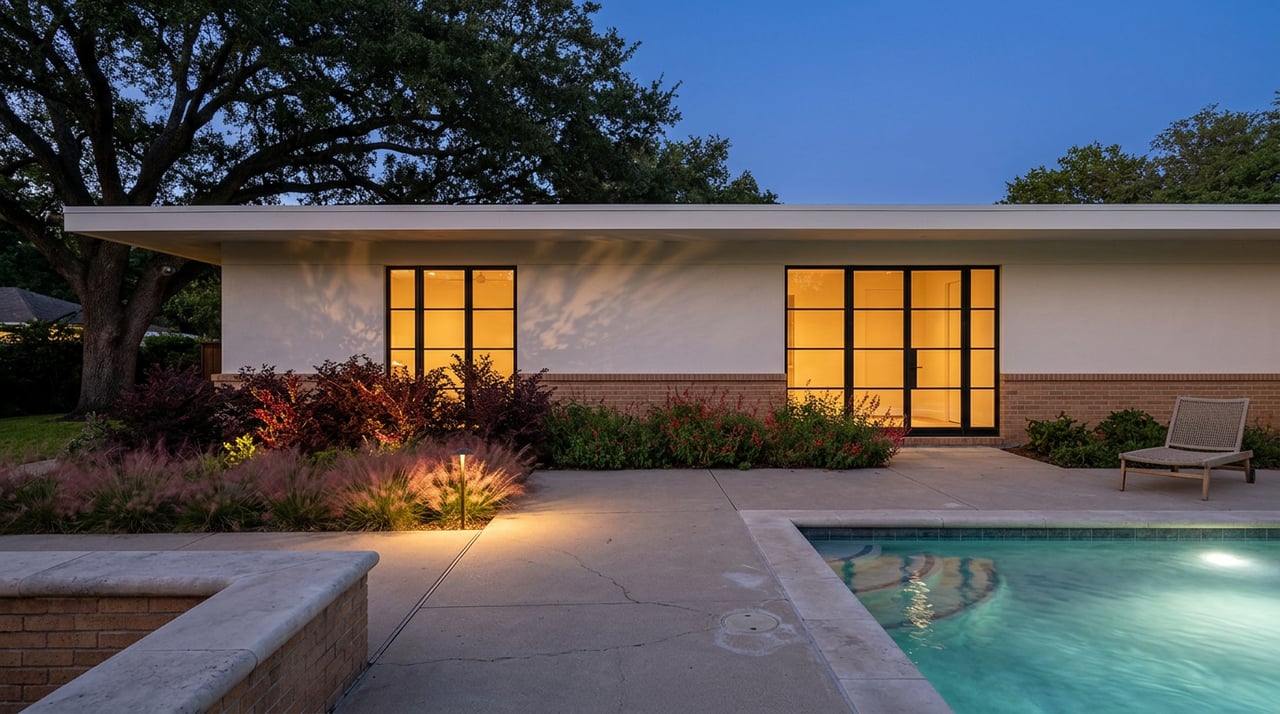
When you are evaluating a luxury home in Austin and the disclosure mentions foundation repair, or your inspector flags signs of movement, the first decision is whether to investigate further or walk away. Both are valid. But if the home is otherwise exactly what you want and the location is right, it is worth understanding the difference between cosmetic evidence and structural failure before making that decision.
Cosmetic cracks are common in Central Texas homes and do not necessarily indicate structural problems. Hairline cracks in drywall, minor separation at wall-ceiling joints, and small cracks in exterior mortar are often the result of normal seasonal movement and settling. These are the symptoms of a house on clay soil, not evidence of failure. Structural concerns become relevant when cracks are wider than a quarter inch, when doors and windows no longer close properly across multiple rooms, when floors slope measurably in one direction, or when exterior brick shows stair-step cracking along the mortar joints.
The most important step a buyer can take is hiring their own licensed structural engineer. Not the seller's engineer, not a recommendation from the seller's agent, and not the general home inspector who includes a foundation assessment as one line item among 200. A structural engineer who works independently for the buyer will evaluate the foundation on its current condition, not on the basis of the seller's repair history or the seller's narrative about how well the repair performed.
The structural engineer will measure floor elevations across the home, identify the direction and magnitude of any slope, assess whether movement is active or stable, evaluate drainage conditions around the perimeter, and provide a written opinion on whether the foundation requires immediate attention, monitoring, or no action. In Barton Hills, where homes sit on variable clay with mature tree canopy, the engineer's assessment of drainage and tree root impact is especially important. In Westlake, where slopes and bedrock depth vary lot by lot, the engineer needs to evaluate whether existing piering is anchored appropriately for the specific geological conditions of that parcel.
Pier and Beam vs. Slab-on-Grade: Different Evaluation
The evaluation process differs depending on the foundation type. Slab-on-grade homes, which are the majority of newer construction in Austin's luxury neighborhoods, are evaluated primarily through elevation measurements and crack pattern analysis. The advantage of slab foundations is that repair through helical piering is well-understood and highly effective. The disadvantage is that plumbing runs under the slab, and foundation movement can crack sewer lines in ways that are not visible until a plumber scopes the pipes.
Pier-and-beam foundations, common in older Barton Hills and Travis Heights homes, allow for crawl space inspection. The buyer's engineer can visually assess the condition of the beams, piers, and joists, check for moisture damage and termite activity, and evaluate whether previous repairs were executed properly. Pier-and-beam foundations are generally easier to repair and monitor, but they are more susceptible to moisture-related deterioration if the crawl space ventilation and drainage are inadequate.
When to Walk vs. When to Negotiate
Walk when: active movement is documented and the seller has not addressed it, when the repair history is poorly documented and the seller cannot produce engineering reports or contractor records, when the structural engineer identifies conditions that suggest the original repair was inadequate, or when the cost of bringing the foundation to stable condition exceeds the discount the seller is willing to offer.
Negotiate when: the repair was professionally executed with complete documentation, a transferable warranty exists, a current independent engineering report confirms stability, and the seller is willing to price the home to reflect the buyer's assumption of the disclosure history. In these situations, a home with foundation history can represent genuine value because most competing buyers walked at the disclosure stage, leaving less competition for a buyer who has done the homework.