Dog's Head: What a 2,600-Acre Development Means for Austin Housing
Austin Market News · August 2026
The short answer: Dog's Head is a nearly four-square-mile mixed-use development on the Colorado River in Southeast Austin, led by Endeavor Real Estate Group, with Amazon's robotics division as the intended anchor tenant. City Council approved the tax financing district 7-3 on July 23. Plans call for more than 12,000 housing units and millions of square feet of commercial space — built out between 2030 and 2057. For central Austin homeowners, the near-term effect is essentially nil. The longer story is about Austin's tax base and how the city now competes for corporate tenants.
This is the biggest development story in Austin this year and it's been covered mostly as a political fight. Here's what's actually approved, what isn't, what the honest housing implications are, and what's worth watching.
Talk Austin MarketCall (512) 608-8811
2,600 Acres Nearly four square miles on the Colorado River | 12,395 Planned Housing Units 6,195 single-family, 6,200 multifamily | $5.63B Infrastructure Estimate The TIRZ covers roughly a fifth of it | 2030–2057 Buildout Window This is a generational project, not a 2027 one |
What and Where
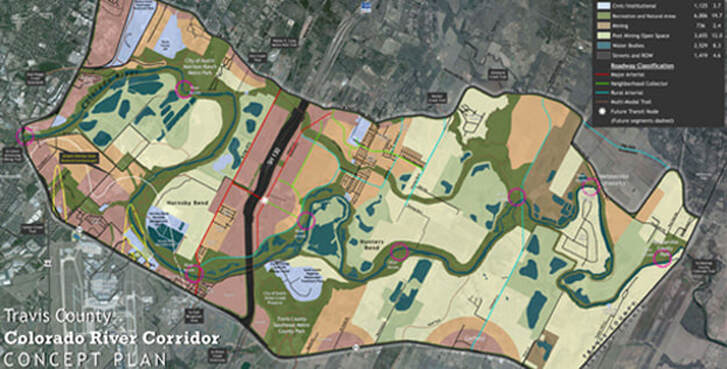
The site sits along the Colorado River in Southeast Austin, between downtown and Austin-Bergstrom International Airport. It gets its name from the shape of the river bend, which on a map resembles a dog's head. The land was previously used for industrial and mining purposes.
Endeavor Real Estate Group is leading it — the Austin firm behind The Domain, Southpark Meadows and the Statesman site redevelopment on South Congress. That track record is a reasonable proxy for what they're capable of building, and also for the scale of ambition.
The published program includes roughly 6,195 single-family homes, 6,200 multifamily units, 4 million square feet of industrial space, 2.5 million square feet of retail, plus office and hospitality, and potentially data centers. Endeavor has also committed to a public trail along the river — more than six miles of it — and open space throughout the property.
Where It Actually Stands
Step | Status |
|---|---|
Annexation and 45-year development agreement | Approved unanimously by City Council in May 2026, effective June 1 |
Anchor tenant identified | Amazon's robotics division, revealed publicly July 21 after months under a nondisclosure agreement |
Tax increment reinvestment zone | Approved by City Council 7-3 on July 23, 2026 |
Travis County participation | Commissioners postponed their vote pending the city's decision — check current status |
Final approval | Not expected until 2027 |
Amazon's commitment | Amazon has said it is considering the site for a manufacturing facility, with roughly 300 to 500 jobs if it proceeds |
Status as reported at the time of writing. This is an actively developing story with multiple approvals still pending — confirm current status before relying on any of it.
That last row is worth sitting with. Amazon's public statement describes a facility it is considering, with 300 to 500 jobs if it moves forward. The project has been characterized in some coverage as a done deal delivering thousands of jobs. It isn't yet either of those things.
How the TIRZ actually works: Endeavor builds the infrastructure — roads, water, sewer — and the city reimburses much of that cost over time from the new property tax revenue the development itself generates. The current structure returns 75 percent of the incremental taxes for twenty years and 66 percent for the fifteen years after. Estimates put the amount diverted at roughly $1.2 billion from the city and $520 million from Travis County. Supporters call it the tool that makes the project possible. Opponents call it a subsidy. Both descriptions are accurate; the disagreement is about whether the trade is worth it.
Why It Moved So Fast
The speed is the source of most of the controversy, and the explanation is straightforward: the city was trying to land Amazon.
Assistant City Manager Eric Johnson said the city moved quickly in an effort to secure Amazon as a tenant, and for months officials argued the timeline depended on it — without being able to name the company, because of confidentiality agreements. Residents learned about the annexation days before Council approved it in May. That sequence is why a lot of people who might otherwise have engaged on the merits feel they were cut out of the process.
Mayor Kirk Watson's argument was essentially that imperfect development inside the city's jurisdiction beats whatever happens outside it — and there was a real alternative on the table. If the TIRZ had been rejected, developers indicated they would seek to de-annex, and the land would likely have been developed as low-density residential through a municipal utility district, generating no tax revenue for Austin at all.
City leaders have also pointed to a broader pressure: with federal funding declining and state-mandated property tax limits constraining revenue, expanding the tax base has become a strategic priority rather than an opportunistic one.
The Opposition, Stated Fairly
The objections are substantive and worth understanding rather than dismissing.
Water quality. The site sits along an ecologically sensitive stretch of the Colorado River. The Save Our Springs Alliance and others have raised questions about runoff and river impacts at full buildout, along with the water and power demands of the proposed uses — and what those demands do to utility rates citywide.
Displacement. PODER and East Austin residents have argued the development will raise surrounding property values and accelerate displacement in neighborhoods already under pressure. Some residents living in the area learned their streets were slated for widening only days before decisions were made.
The affordable housing commitment. The agreement contemplates 20 percent affordable housing, but reporting indicates there is no binding commitment to actually build units. Critics have also noted that any affordable housing built would sit near industrial facilities and across the river from Tesla's gigafactory.
The subsidy itself. Without the TIRZ, that revenue would flow to the city's general fund for public safety, parks, libraries and social services. Whether redirecting it toward infrastructure that enables a private development is a good use of public money is a genuine policy disagreement, not a technicality.
Wondering how Austin's growth affects your property?
Most large-scale development news matters less to an individual home than the headlines suggest, and occasionally it matters more. The Davis Agency has watched Austin's growth cycles from the inside since 2006 and is happy to give you a straight read.
What It Actually Means for Housing
Here's the part most coverage skips, so let's be plain about it.
The timeline is the headline. Buildout runs from 2030 to 2057. Final project approval isn't expected until 2027. Nothing about this affects Austin housing supply in any meaningful way for years, and the full 12,000-plus units arrive across three decades. Treating it as near-term supply is a category error.
It's not a central Austin story. Southeast Austin near the airport is a different submarket from Barton Hills, Zilker, Bouldin Creek or Travis Heights in every respect that matters — buyer pool, price point, product type, school district. A buyer choosing between a 78704 teardown and a new house at Dog's Head in 2032 is not a real person. The two don't compete.
The nearby effects are real and local. Southeast Austin neighborhoods adjacent to the site are where this lands. Increased values, increased traffic, and the displacement pressure residents have raised are all plausible outcomes in that immediate area — which is exactly why those residents are the ones showing up to testify.
The job number is modest so far. Amazon's stated figure is 300 to 500 positions if it proceeds. That's meaningful for the neighborhood and it is not a scale of employment that moves a metro housing market. The larger commercial program could generate considerably more over decades, but that's a projection rather than a commitment.
What might genuinely matter long-term is the tax base. If the development performs as projected, it eventually generates substantial revenue for a city facing real fiscal constraints. That's a slow-moving benefit that shows up in city services and rate pressure rather than in anyone's home value — and it's the argument supporters are actually making, stripped of the job-creation framing.
The Precedent Is the Real Story
Strip away the specifics and what happened here is a template: fast-track an annexation, sign a long development agreement, create a tax financing district, and do it under a confidentiality agreement because a large corporate tenant required it.
Whether you think that's good governance or bad, it's now a demonstrated approach, and Austin has signaled it will use these tools to compete for employers. Anyone reading the Austin market over the next decade should expect to see it again — and the political reaction to this one will shape how much easier or harder the next one is.
That's the thing actually worth watching, more than any projection about 2057.
What to Watch Next
Whether Travis County joins the TIRZ. Commissioners postponed pending the city's vote. The financing assumes their participation, and the county's roughly $520 million share is not a rounding error.
Whether Amazon actually commits. The company has confirmed it's considering the site. A signed commitment is a different thing, and the entire urgency argument rests on it.
The 2027 final approval. The TIRZ was one step. The regulating plan and remaining approvals give opponents further opportunities and give the details a chance to change.
Whether the affordable housing becomes binding. Twenty percent of 12,000-plus units would be significant. A 20 percent target with no obligation to build is not the same thing, and which one this turns out to be is worth tracking.
Frequently Asked Questions
What is the Dog's Head development in Austin?
A proposed mixed-use development on roughly 2,600 acres — nearly four square miles — along the Colorado River in Southeast Austin between downtown and the airport, led by Endeavor Real Estate Group. It's named for the shape of the river bend. Plans include about 6,195 single-family homes, 6,200 multifamily units, 4 million square feet of industrial space, 2.5 million square feet of retail, plus office and hospitality, with buildout projected from 2030 to 2057.
Is Amazon building at Dog's Head?
Amazon's robotics division was publicly identified in July 2026 as the intended anchor tenant, after months under a nondisclosure agreement. Amazon has stated it is considering the site for a proposed manufacturing facility and that it would create approximately 300 to 500 jobs if the project moves forward. That is a stated consideration rather than a finalized commitment.
Will Dog's Head lower home prices in Austin?
Not in any near-term or central-Austin sense. Buildout runs from 2030 to 2057, so the housing arrives gradually across three decades, and the site is in Southeast Austin near the airport — a different submarket from central neighborhoods in price, product and school district. The more immediate local effects are concentrated in adjacent Southeast Austin neighborhoods, where residents have raised concerns about rising values and displacement.
Why is the Dog's Head project controversial?
Several reasons. The approval process moved unusually fast, with residents learning of the annexation days before the Council vote, because the city was trying to secure Amazon under a confidentiality agreement. Environmental groups have raised water quality concerns given the site's location on a sensitive stretch of the Colorado River, along with questions about water and power demand. East Austin advocates have raised displacement concerns. And the tax financing structure diverts an estimated $1.2 billion from the city and $520 million from Travis County that would otherwise fund general services.
Related Reading from The Davis Agency
→ Who's Actually Hiring in Austin Tech — and Where They're Buying
Questions About the Austin Market?
Big development news generates a lot of noise and occasionally a signal. If you want a straight read on what any of it means for a specific property or neighborhood, that's a conversation worth having. The Davis Agency has worked this market since 2006.
Start the ConversationCall (512) 608-8811
Derrik Davis · Broker/Owner, The Davis Agency · CLHMS Certified · TREC License #558841 · Serving 78704 and the greater Austin luxury market since 2006. This is an actively developing story and details reported here reflect the status at the time of writing. Confirm current information before relying on it. This article is general market commentary and is not investment advice.